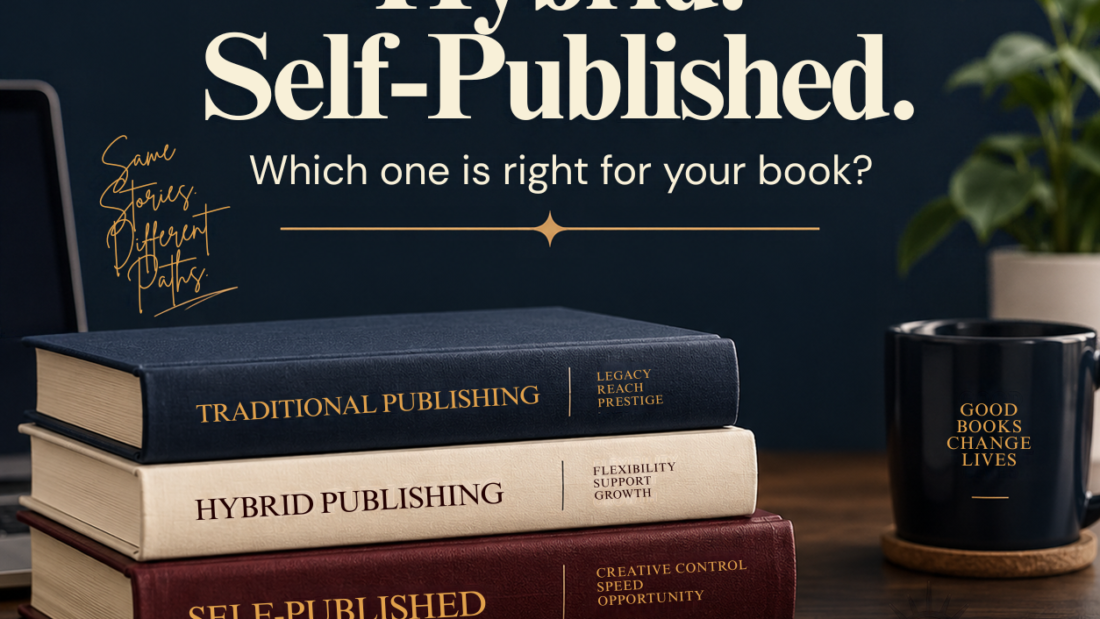
the self-publishing vs traditional publishing conversation is the first one we have with almost every author who comes to us.
Before we talk about marketing, before we talk about services, before anything else.
So let’s walk through the three main routes honestly, including the trade-offs nobody puts on the sales page.
Traditional Publishing: The Route Most People Picture
When people think about self-publishing vs traditional publishing, traditional is usually what comes to mind first.
You land an agent, the agent sells your manuscript to a publishing house.
And the house handles editing, design, printing, and distribution, all without you paying anything upfront.
In exchange, you typically keep around 10 to 15% of the royalties, and the publisher owns significant creative decisions along the way.
Traditional publishing makes sense when:
You want the credibility and reach of an established imprint
You don’t want to pay anything out of pocket
You’re comfortable with a long timeline, realistically 12 to 24+ months from signing to shelf
You’re prepared to build an author platform first, since most agents and editors expect to see one before they’ll consider your manuscript
Where it gets hard: Landing an agent is genuinely competitive, and even after that, a publisher’s marketing support varies wildly depending on the imprint and how big your advance was.
Many traditionally published authors are still expected to drive a meaningful share of their own visibility, which is exactly where the self-publishing vs traditional publishing lines start to blur.
Hybrid Publishing: The Middle Ground
Hybrid publishing sits between the two. You pay a publisher, typically somewhere between $2,500 and $15,000 depending on scope, for professional grade editing, design, and distribution, while keeping a higher royalty share and more creative control than a traditional deal offers.
Hybrid publishing makes sense when:
You want a faster timeline than traditional, but more polish and support than doing it entirely alone.
You have some budget to invest and want it to buy real production quality.
Did you want a higher royalty percentage without giving up full creative control
Where it gets hard: “Hybrid publisher” isn’t a protected term, so the space includes both genuinely reputable companies and vanity presses charging premium prices for very little real service.
Vetting who you’re working with matters more here than in either other route.
Reputable industry watchdogs like the Alliance of Independent Authors maintain guidance specifically to help authors tell the two apart.
Self-Publishing: Full Control, Full Responsibility
Self-publishing means you control, and fund, every part of the process yourself:
editing, cover design, formatting, distribution (usually through Amazon KDP and similar platforms), and marketing.
In exchange, you keep 100% of your rights and the highest royalty percentage of the three routes, and you can move to market faster than either alternative.
That speed is often the deciding factor in the self-publishing vs traditional publishing decision for authors working against a deadline.
Self-publishing makes sense when:
You want full creative control over your book, cover, and pricing
You want to move quickly rather than wait on an external timeline
You’re willing to either learn the moving pieces (editing, formatting, Amazon optimization, marketing) or bring in help for the parts you don’t want to handle yourself
Where it gets hard:Every piece, quality editing, a professional cover, correct formatting, Amazon discoverability, and any marketing at all, is on you to source and fund.
This is also where the largest number of authors land, and it’s exactly where a marketing partner tends to add the most value, since discoverability rarely happens by accident.
This is where we come in. Horizon Literary Group works specifically with self-published authors to handle the Amazon optimization, positioning, and visibility work that’s hardest to do alone.
So, Which Side of the Self-Publishing vs Traditional Publishing Decision Are You On?
There isn’t a universally “best” answer to the self-publishing vs traditional publishing question, only the one that fits your specific timeline, budget, and how much control you want to keep.
A debut literary novelist chasing traditional credibility, a business author who wants a polished book fast for speaking engagements, and a romance writer planning to publish three books a year all have very different right answers, even though they’re weighing the same trade-offs.
If you’re still not sure which route fits your book, that’s a completely normal place to be. And it’s exactly the kind of question worth answering before you spend money on any service, ours or anyone else’s.
Get a Free Audit Before You Decide
We put together a free audit for authors in exactly this position: a real look at your Amazon listing or your current online presence, with two or three specific things you could fix this week, no matter which side of the self-publishing vs traditional publishing decision you land on.
Horizon Literary Group helps authors across traditional, hybrid, and self-publishing routes get their books properly positioned, published, and marketed. Elevating Stories. Expanding Horizons.
The Truth About Self-Publishing in 2026: What Nobody Tells New Authors
Self-publishing in 2026 gives authors more control over their books than ever before. However, that freedom also comes with more decisions, more competition, and more responsibility.
Publishing a book is no longer just about uploading a manuscript and waiting for readers to find it. Authors must think about editing, cover design, formatting, distribution, metadata, discoverability, marketing, and their long-term author platform.
The good news is that you do not need to master everything yourself. You do, however, need to understand how the modern publishing industry works before deciding where to invest your time and money.
This guide explains the realities of self-publishing in 2026 and the things new authors should understand before bringing a book to market.
Self-Publishing in 2026 Is a Real Publishing Business
One of the biggest changes in independent publishing is how professional the industry has become.
Self-publishing once carried a reputation for being the route authors chose when they could not secure a traditional publishing deal. That view no longer reflects the entire industry.
Today, authors choose independent publishing for many reasons. Some want creative control. Others want faster publishing schedules, control over pricing, or ownership of their publishing decisions.
However, independence does not remove the need for professional standards.
Readers still expect a polished book.
That means authors need to consider editing, proofreading, cover design, interior formatting, metadata, distribution, and marketing.
Think like both a writer and a publisher.
Writing creates the book. Publishing creates the product that readers will actually encounter.
Uploading Your Book Is the Easy Part
Publishing technology has removed many barriers that once kept authors out of the market.
Platforms such as Amazon Kindle Direct Publishing allow authors to make print and digital books available without working with a traditional publishing house.
That accessibility is valuable.
It can also create a dangerous misconception.
Uploading a manuscript is not the same as building a successful publishing strategy.
Almost anyone can make a book available online. The harder challenge is convincing the right reader to notice it, trust it, and eventually buy it.
Before publication, an author may need to address:
Not every author needs the same combination of services.
A novelist publishing the first book in a fantasy series has different needs from a consultant publishing a business book.
Your publishing strategy should reflect your book, audience, budget, and long-term goals.
Distribution and Discoverability Are Not the Same Thing
This is one of the most important lessons for anyone considering self-publishing in 2026.
Distribution makes your book available. Discoverability helps readers find it.
The difference matters.
An author can distribute a book across several retailers and still receive very few sales. The book exists, but potential readers may never encounter it.
Modern book discovery can happen through search engines, online retailers, Goodreads, author websites, newsletters, podcasts, social media, book clubs, media coverage, recommendations, and reader communities.
Therefore, authors should ask two separate questions:
Where can someone buy my book?
And:
How will someone discover that my book exists?
A strong publishing strategy needs an answer to both.
Amazon Matters, but It Is Not the Entire Publishing Industry
Amazon remains an important marketplace for independent authors. For many writers, it will form a major part of their publishing strategy.
However, it is not the only route to readers.
Depending on your publishing goals, you may also encounter platforms and distribution services such as Amazon KDP, IngramSpark, Apple Books, Kobo, Barnes & Noble Press, and Draft2Digital.
Each serves a different purpose.
Some authors focus heavily on Amazon. Others want broader ebook distribution. Some want their books available for bookstores and libraries to order.
There is no universal distribution setup that works for every author.
Start with your readers.
Where do they buy books? What formats do they prefer? Are you targeting primarily U.S. readers or an international audience? Do libraries and independent bookstores matter to your strategy?
Those answers should influence your distribution decisions.
Your Book Cover Has a Marketing Job
Authors often approach cover design as a purely creative decision.
It is also a marketing decision.
A cover must attract attention while quickly communicating what kind of reading experience the book offers.
Imagine someone scrolling through dozens of books.
They may only spend a few seconds looking at each cover.
During those seconds, your design needs to create the right expectation.
A thriller should visually communicate something different from a children’s book. A historical romance should not look like a corporate leadership guide.
Study successful books within your category.
Look for patterns in typography, imagery, composition, and tone. You should not copy another author’s design. Instead, learn the visual language readers already associate with your genre.
A beautiful cover that attracts the wrong audience can still be an ineffective cover.
Professional Editing Still Matters
Technology can help writers identify spelling mistakes and awkward sentences. AI tools can also assist with certain parts of the writing and editing process.
Neither development removes the value of human editorial judgment.
Authors become extremely familiar with their manuscripts. After reading the same chapters repeatedly, it becomes difficult to see problems objectively.
A professional editor can provide that outside perspective.
Depending on the manuscript, an author may need developmental editing, line editing, copyediting, or proofreading.
These services are not interchangeable.
Developmental editing examines larger issues such as structure, pacing, argument, plot, and character development.
Copyediting focuses more closely on clarity, grammar, consistency, and correctness.
Proofreading usually happens near the end. It catches remaining errors before publication.
Understanding what your manuscript actually needs can prevent you from spending money on the wrong stage of editing.
Metadata Can Determine Whether Your Book Gets Found
Metadata is not the most exciting part of publishing.
It is still important.
Book metadata gives retailers, databases, search systems, booksellers, and readers information about your book.
It can include your:
Book title
Subtitle
Author name
Description
ISBN
Categories
Keywords
Publication date
Format
Series information
Think of metadata as the information systems use to understand where your book belongs.
If you categorize a book poorly or use vague descriptions, you can make discovery harder.
For example, calling your novel simply “fiction” provides far less useful information than accurately identifying its genre and audience.
Good metadata helps create context.
That context matters when readers search, browse categories, or receive recommendations.
Self-Publishing in 2026 Requires an Author Platform
You do not need 100,000 social media followers to have an author platform.
An author platform is simply the network of places where people can discover you, learn about your work, and stay connected.
Your platform might include:
An author website
An email newsletter
Goodreads
Amazon Author Central
Social media
Podcast appearances
Media interviews
Speaking engagements
Book clubs
Reader communities
Blog content
The right combination depends on the author.
A nonfiction expert might gain more value from Google search visibility, LinkedIn, podcasts, and speaking engagements.
A romance author might focus more heavily on newsletters, reader groups, series pages, Goodreads, and genre communities.
Trying to dominate every platform usually wastes time.
Instead, identify where your ideal readers already spend their attention.
Then build consistently in those places.
Your Author Website Should Do More Than Look Good
A professional author website gives you something that retailer pages cannot: a digital platform you control.
Your website can introduce your books, tell your story, collect email subscribers, promote appearances, host useful content, and direct readers toward places where they can buy your work.
It can also help readers discover you through search engines.
That last point is often overlooked.
For example, an author who writes historical fiction about a particular place or period could publish useful articles around those subjects. Those articles may attract people already interested in the world surrounding the book.
A nonfiction author can answer questions related to the problems addressed in their book.
Over time, useful content can create multiple paths through which people discover the author.
Your website should therefore function as part of your publishing and discoverability strategy, not simply as an online business card.
Do Not Wait Until Publication Day to Start Marketing
This mistake can make a book launch unnecessarily difficult.
An author spends months or years writing a book. The manuscript is finally complete. The cover is ready.
Then comes the question:
How do I market it?
Marketing should ideally enter the conversation earlier.
You can begin defining your audience before publication. You can prepare your website, retailer profiles, email list, media materials, launch content, and outreach strategy while the book moves through editing and production.
This does not mean promoting an unfinished book constantly.
It means building the foundation before you need it.
When publication day arrives, you should already know who the book is for and how you intend to reach those readers.
Book Marketing Does Not End After Launch Week
Launches receive a lot of attention in publishing.
They matter, but they are only one part of a book’s life.
An effective long-term strategy can continue creating opportunities months after publication.
An author might appear on a podcast six months later. A blog article could begin attracting Google traffic. A book club might discover the title after a local event. A new book might introduce readers to the author’s previous work.
This is why authors should build assets instead of relying entirely on short promotional campaigns.
An email list is an asset.
A well-optimized author website is an asset.
Strong search visibility is an asset.
Reader relationships are assets.
Quality media coverage can become an asset.
The more useful publishing assets you build, the less dependent you become on repeatedly paying for short bursts of attention.
Be Careful With Publishing Companies That Promise Guaranteed Success
The growth of self-publishing has also created a large market for publishing and book marketing services.
Many companies provide legitimate professional support.
Others rely heavily on authors’ hopes and lack of industry experience.
Be cautious when someone guarantees bestseller status, thousands of sales, major media coverage, or specific financial returns.
No ethical publishing professional can control reader behavior.
Before paying a publishing or marketing company, ask clear questions.
What exactly will they deliver?
Who owns the finished files?
What distribution channels will they use?
How will they report marketing activity?
Are there additional third-party costs?
What happens after the project ends?
Can they explain their strategy without hiding behind vague marketing language?
A good provider should help you understand what you are purchasing.
You should never feel pressured to buy an expensive package simply because someone tells you your book will fail without it.
AI Is Changing Publishing, but Authors Still Matter
You cannot discuss self-publishing in 2026 without discussing artificial intelligence.
AI tools now influence many creative and business industries, including publishing.
Authors may use AI-assisted technology for brainstorming, research organization, marketing analysis, administrative tasks, content planning, or workflow support.
However, authors should use these tools thoughtfully.
Publishing platforms may have rules concerning AI-generated or AI-assisted material. Copyright questions can also become complicated.
Always check the current requirements of the platforms you use.
More importantly, remember what readers ultimately connect with.
They connect with perspective.
They connect with experience.
They connect with characters, ideas, emotion, expertise, and storytelling.
Technology can support a publishing workflow. It should not make an author’s individual voice irrelevant.
Self-Publishing in 2026, Costs Can Vary Dramatically
One of the most common questions new authors ask is:
How much does it cost to self-publish a book?
There is no single correct number.
Costs depend on the condition of the manuscript, book length, genre, format, design requirements, distribution strategy, and marketing goals.
An author who already has professional editing and artwork may need far less support than someone starting with an unfinished manuscript.
That is why authors should be cautious about buying large publishing packages before understanding what they actually need.
Break the process into stages.
Determine what has already been completed professionally.
Then identify the gaps.
Your publishing budget should follow your priorities rather than somebody else’s package.
Should You Self-Publishing in 2026 or Choose Traditional Publishing?
Neither publishing route is automatically better.
They offer different advantages.
Traditional publishing may provide editorial infrastructure, established industry relationships, distribution support, and the credibility associated with a recognized publishing house.
However, the process can be highly selective and slow.
Self-publishing gives authors greater control over schedules, pricing, creative decisions, and the professionals they hire.
It also places more responsibility on the author.
Instead of asking which method is universally best, ask:
Which publishing model fits my goals for this book?
Consider your timeline, budget, audience, desired level of control, marketing expectations, and long-term writing plans.
The right answer may even change from one book to another.
What New Authors Should Do Before Self-Publishing in 2026
Before you publish, take a moment to answer these questions:
Who is the ideal reader for my book?
What genre or category does it belong to?
Has the manuscript received the right level of editing?
Does my cover fit reader expectations for the genre?
Are my print and digital editions professionally formatted?
Which distribution platforms make sense for my goals?
Have I prepared accurate and compelling metadata?
Where will readers discover me online?
Do I have a professional author website or platform?
What is my plan for reaching readers after launch?
How will I measure the results of my marketing?
Which publishing tasks can I manage myself, and where do I need professional support?
You do not need perfect answers to everything.
You should, however, understand these questions before spending heavily on publishing or marketing.
The Real Truth About Self-Publishing in 2026
Self-publishing in 2026 creates remarkable opportunities for authors.
You can retain control of your work. You can reach readers around the world. You can choose your publishing team and build a long-term author brand around your books.
But accessibility does not guarantee visibility.
The difficult part is rarely pressing the publish button.
The real work involves producing a professional book, understanding your audience, choosing appropriate distribution, building discoverability, and creating reasons for readers to remain connected.
Successful independent authors do not have to do everything themselves.
They need to know what matters, what they can handle effectively, and when professional support can improve the final result.
Publishing technology will continue to change.
Reader behavior will change too.
Yet one principle will remain important: create a strong book, present it professionally, put it where the right readers can find it, and continue building relationships after publication.
Ready to Take the Next Step?
Every author’s publishing journey starts from a different place.
You may have a completed manuscript that needs professional editing. Perhaps your book is already published but struggling to reach readers. Or you may need help with design, distribution, an author website, branding, or a long-term marketing strategy.
Horizon Literary Group supports authors across different stages of that journey.
Instead of starting with services you may not need, start by identifying where your book stands today and what is preventing you from reaching the next stage.
That clarity can help you make smarter publishing decisions and build a stronger foundation for the future of your work.
The Truth About Book Metadata: Why Good Books Stay Invisible Online
Book metadata can determine whether the right readers discover your book or scroll past it without ever knowing it exists. Yet many authors spend months perfecting a manuscript and only a few minutes thinking about the information attached to it.
That is a costly mistake.
Your title, subtitle, description, categories, keywords, author information, ISBN, and other publishing details help retailers and discovery systems understand your book. More importantly, they help potential readers decide whether your book belongs on their reading list.
A professionally written book can still struggle online when its book metadata sends weak or confusing signals.
So, what exactly is book metadata, why does it matter, and what should authors do before publishing?
Image ALT: book metadata for authors preparing a book for publication
What Is Book Metadata?
Book metadata is the information used to describe and identify a book.
Think of your manuscript as the product and metadata as the information surrounding that product.
Depending on the publishing platform and book format, metadata can include:
Book title
Subtitle
Author name
Contributors
Book description
ISBN
Publisher or imprint
Keywords
Categories
Primary audience
Publication date
Language
Series information
Book format
Amazon KDP’s official metadata guidelines explain the information authors and publishers provide when preparing a title. Amazon uses these details to understand and present books within its store.
That makes book metadata much more than publishing paperwork.
It helps establish what your book is, who created it, where it belongs, and how readers should understand it.
Why Book Metadata Matters for Discoverability
Imagine walking into a huge bookstore where none of the shelves have labels.
Mysteries sit beside cookbooks. Children’s books appear beside business guides. Historical fiction gets mixed with personal finance.
Finding the right book would become frustrating.
Online bookstores need ways to organize enormous catalogs. Book metadata helps them do that.
For example, Amazon explains that categories are sections of its store where customers can find books. Keywords provide additional information that can help connect books with relevant searches.
That means poor metadata can create a discoverability problem before your marketing campaign even begins.
Your book might be excellent.
However, if retailers struggle to understand what it is, finding the right audience becomes harder.
Book Metadata Is Not the Same as Book Marketing
Authors sometimes treat metadata and marketing as the same thing.
They are connected, but they serve different purposes.
Book metadata helps platforms and readers interpret the book correctly once they encounter it.
For example, a podcast interview might send someone to your Amazon page.
That is marketing.
The title, description, categories, keywords, cover, and other information they encounter help them understand whether the book interests them.
That is where metadata and positioning become important.
A strong publishing strategy needs both.
Your Book Title Is Part of Your Metadata
Your title deserves careful attention long before publication.
It needs to represent the book accurately while remaining memorable and appropriate for its audience.
For nonfiction, a subtitle can also help communicate the subject or promise more clearly.
However, authors should not turn titles and subtitles into keyword containers.
According to Amazon KDP’s official title guidelines, the title field should contain the actual title shown on the book cover. Amazon also prohibits adding unrelated keywords or unauthorized references to other books or authors.
This is an important distinction.
SEO matters.
Clarity matters.
But manipulation can create problems.
Your title should first serve the book and its readers.
Your Book Description Has Two Jobs
A book description needs to communicate information and create interest.
For fiction, that usually means introducing the central conflict without giving away the entire story.
For nonfiction, it often means showing readers the problem, idea, transformation, or knowledge they can expect from the book.
A weak description often tries to explain everything.
A stronger one creates enough understanding to help the right reader make a decision.
Keep the opening especially strong.
Many people scan before they read closely.
Therefore, the first few lines should quickly establish what makes the book relevant or compelling.
Your description should also remain consistent with your wider positioning.
If your cover suggests a psychological thriller but your description sounds like a lighthearted mystery, readers may become confused.
Good book metadata works together.
Keywords Help Readers Find Relevant Books
Keywords are one of the most misunderstood parts of book metadata.
They are not simply words authors want to rank for.
They should accurately describe the book while reflecting language potential readers may use when searching.
Amazon KDP’s keyword guidance currently allows publishers to choose up to seven keywords related to a book’s content. Amazon also recommends avoiding vague keywords.
For fiction, useful keyword ideas might relate to:
Setting
Character type
Character role
Plot theme
Story tone
Genre elements
For nonfiction, they may relate to:
Reader problems
Subject matter
Professional fields
Skills
Outcomes
Specific areas of interest
Suppose you wrote a historical mystery set in Victorian London.
A vague term such as “book” tells a retailer almost nothing.
More specific language connected to Victorian crime, historical mystery, detectives, or the story’s actual themes provides much better context.
Specificity matters.
Do Not Stuff Keywords Into Your Book Metadata
More keywords do not automatically produce better discoverability.
Relevance matters more.
Trying to manipulate search systems with unrelated authors, popular book titles, promotional claims, or misleading phrases can violate platform rules.
Amazon’s metadata guidelines warn against keywords that misrepresent a book. References to other authors, unrelated books, sales rankings, and certain promotional language can also violate its keyword requirements.
Therefore, adding the name of a famous author simply because your audience overlaps with theirs is not a smart shortcut.
Neither is filling metadata fields with phrases that have nothing to do with your book.
Your goal should be simple:
Help the platform understand your book accurately.
Then help the right reader recognize it.
Book Categories Can Put You in Front of the Right Audience
Categories help organize your book within retailer stores.
They also influence the competitive environment around your title.
A broad category may contain an enormous number of books.
A more specific and accurate category can place your title among books that share stronger similarities.
However, authors should not choose irrelevant categories simply because they appear easier to rank in.
That creates the wrong kind of visibility.
You want readers who are genuinely interested in what you wrote.
Amazon’s current book metadata guidelines allow KDP publishers to choose up to three categories during title setup. Those categories should accurately reflect the book’s content and intended audience.
Think like a bookseller.
If someone asked where your book belonged in a physical bookstore, which section would you choose?
Image ALT: author researching book metadata keywords and categories
Your Cover and Metadata Should Tell the Same Story
Book metadata does not operate alone.
Your book cover design contributes to the reader’s understanding of your book.
Imagine finding a book categorized as dark psychological suspense with a bright, playful cover that resembles a romantic comedy.
Something feels wrong immediately.
The metadata says one thing.
The visual identity says another.
Strong publishing creates consistency between:
Cover design
Title
Subtitle
Description
Categories
Keywords
Author branding
Intended readership
Every element should reinforce the same positioning.
If your cover or interior does not yet meet professional publishing standards, professional design and formatting should become part of the publishing process rather than an afterthought.
ISBNs Are Identifiers, Not Marketing Tools
Authors also encounter ISBNs when preparing books for publication.
An ISBN, or International Standard Book Number, identifies a particular book and edition.
It does not make a book popular.
It does not improve the quality of the manuscript.
And it does not replace marketing.
It serves an identification function within the publishing ecosystem.
According to Amazon KDP’s ISBN guidance, Kindle eBooks do not require an ISBN on KDP. Paperback and hardcover books can qualify for a free KDP ISBN, or publishers can provide an ISBN they obtained themselves.
Do not wait until the final upload screen to learn what these identifiers mean.
Publishing decisions become easier when you understand them beforehand.
Book Metadata Should Stay Consistent Across Platforms
Many independently published books appear in several places.
An author may have an Amazon listing, an author website, Goodreads presence, distributor records, social profiles, and other retailer pages.
Inconsistency across those platforms can weaken the professional presentation.
For example, imagine finding three different versions of the same book description.
Or different subtitles.
Or inconsistent author names.
These small problems can create unnecessary confusion.
Create a master metadata document before publication.
Store your approved:
Title
Subtitle
Author name
Author biography
Short book description
Long book description
ISBN information
Keywords
Categories
Publication information
Series information
Website address
Retail links
Then use that document as your central reference.
Consistency saves time and reduces mistakes.
Your Author Website Can Strengthen Book Discoverability
Retailer metadata helps people discover your book inside retail ecosystems.
Your author website can expand that discoverability beyond them.
A properly structured website can provide dedicated pages for your books, author information, interviews, media appearances, articles, events, and reader resources.
It can also give search engines more context about you and your work.
That becomes particularly valuable for authors building a long-term career.
Instead of relying completely on retailer pages you do not control, you create a central digital home for your author brand.
Your book pages should also use accurate titles, descriptions, images, and structured information.
The same principle applies everywhere:
Make it easy for both people and digital systems to understand what you offer.
Metadata Mistakes Authors Should Avoid
Some book metadata problems are surprisingly easy to prevent.
Before publishing, look for these common mistakes:
Choosing Categories Based Only on Competition
An irrelevant category might appear easier to rank in, but it can attract the wrong readers.
Accuracy should come first.
Using Keywords That Are Too Broad
Words such as “fiction,” “novel,” or “book” provide little context by themselves.
Get more specific.
Copying Another Author’s Keywords
Another author’s strategy may not fit your book.
Research your own audience and positioning.
Writing a Description Without the Reader in Mind
A description should not read like private notes about your manuscript.
Write it for someone deciding whether to buy the book.
Changing Your Book Information Everywhere
Maintain a central metadata document so your information remains consistent.
Waiting Until Launch Day
Metadata deserves attention before publication.
Rushing it during the final upload can lead to poor decisions.
Can You Change Book Metadata After Publishing?
In some cases, yes.
However, not every field remains editable after publication.
Amazon’s current book-detail update guidance says authors can change certain information after publication, including descriptions, keywords, categories, territories, and pricing.
However, other information becomes locked.
For example, book titles and subtitles generally cannot be freely changed after publication. Some locked changes require the publisher to create a new edition.
This is another reason to prepare carefully.
A typo in an easily editable description is inconvenient.
A mistake in a locked publishing field can become much more complicated.
Review everything before clicking publish.
Then review it again.
How Book Metadata Fits Into Self-Publishing in 2026
Modern independent publishing requires authors to think beyond the manuscript.
In our guide to self-publishing in 2026, we explained why making a book available is not the same as making it discoverable.
Book metadata is one of the clearest examples of that difference.
Publishing platforms can distribute your book.
However, they still need accurate information to understand what they are distributing.
Readers need that information too.
A Book Metadata Checklist Before You Publish
Before submitting your book, review these questions:
Does my title exactly match the title on my cover?
Does my subtitle clearly support the book’s positioning?
Is my author name consistent everywhere?
Does my description appeal to my ideal reader?
Have I chosen accurate categories?
Do my keywords reflect genuine reader searches?
Have I removed misleading or irrelevant terms?
Is my ISBN information correct for the format?
Does my cover match the genre and audience?
Is my series information consistent?
Does my author website use the same core information?
Have I checked the current requirements of each publishing platform?
Do not treat this as administrative busywork.
Each answer contributes to how clearly the publishing ecosystem understands your book.
If the manuscript itself still needs work before you reach this stage, professional editing and proofreading can help ensure the book’s presentation starts with a strong manuscript.
The Truth About Book Metadata
Book metadata cannot rescue a weak book.
It cannot guarantee bestseller status.
And it cannot replace a thoughtful marketing strategy.
What it can do is remove unnecessary barriers between your book and the people who may want to read it.
Horizon Literary Group helps authors bring those pieces together across the publishing journey.
Whether you are preparing a manuscript for publication or trying to improve an existing book’s discoverability, begin by identifying the gaps that are holding the book back.
If you need support determining the next practical step, contact Horizon Literary Group to discuss where your book currently stands.
A strong publishing foundation does not guarantee overnight success.
It does, however, give your book a much better chance of reaching the readers it was written for.
The Truth About Book Marketing: Why Most Authors Start Too Late
Book marketing often becomes an author’s priority at exactly the wrong time: after the book has already been published.
Months or even years go into writing. Then come editing, proofreading, cover design, formatting, and publishing. Finally, the book goes live.
Only then does the author ask:
How do I get people to buy it?
That approach makes book marketing much harder than it needs to be.
Effective marketing starts before publication. It begins with understanding who the book is for, where those readers spend their time, how they discover books, and why they should pay attention to yours.
Marketing does not mean shouting about your book every day.
It means creating multiple ways for the right readers to discover it.
Book marketing is the process of creating awareness, interest, and demand for a book among its intended readers.
That sounds simple.
In practice, it can involve several connected activities.
Authors may use:
Author websites
Email newsletters
Social media
Goodreads
Amazon Author Central
Podcasts
Media outreach
Book clubs
Reader communities
Events and speaking engagements
Search engine optimization
Book reviews
Retailer optimization
Paid advertising
Giveaways
Content marketing
You do not need to use every channel.
In fact, trying to do everything often creates more activity without creating better results.
Good book marketing starts by choosing the channels that make sense for your book and audience.
Book Marketing Should Begin Before Publication
One of the biggest mistakes authors make is treating marketing as the final stage of publishing.
It should begin much earlier.
This does not mean running advertisements for a manuscript that is nowhere near finished.
Instead, early marketing means building the foundation that you will need later.
For example, before publication you can identify your ideal readers, establish your author brand, create your website, prepare your email list, research media opportunities, and develop your launch strategy.
Amazon itself allows publishers to use certain release and pre-order options before a book becomes available, depending on the format.
The important lesson is simple:
Do not wait until you need attention to start building an audience.
Consider a historical novel set during World War II.
Its potential audience might include historical-fiction readers, people interested in the particular location, readers interested in the historical event, book clubs, and communities connected to the subject.
Now consider a book about leadership.
Its audience and marketing channels could look completely different.
That author might focus on LinkedIn, podcasts, professional associations, speaking opportunities, Google search, and an email list.
The book determines the audience.
The audience helps determine the channels.
Not the other way around.
Your Book Marketing Strategy Needs Clear Positioning
Before convincing people to buy a book, you need to communicate what makes it relevant to them.
That is positioning.
Can you explain your book clearly in one or two sentences?
Can a reader quickly identify its genre?
Does your cover match that genre?
Does your description communicate the central appeal?
Do your categories and keywords accurately represent the book?
These questions connect marketing directly with the book metadata decisions we discussed in our previous guide.
Your positioning should remain consistent across your cover, retailer listings, website, social profiles, interviews, and promotional material.
Confusion creates friction.
Clarity makes marketing easier.
Distribution Is Still Not Book Marketing
Making a book available through Amazon and other retailers is not the same as marketing it.
Distribution answers:
Where can someone buy my book?
Marketing answers:
Why would someone know that my book exists?
This distinction matters because authors sometimes believe broad distribution will automatically generate readers.
It usually doesn’t.
Amazon KDP itself separates publishing from promotion. Its publishing guidance lists promotion as a distinct step and provides authors with tools such as Author Central, advertising, promotional programs, and enhanced book-detail content.
Your website is also one of the few major pieces of your author platform that you control.
Social networks can change algorithms.
Retailers can change policies.
Platforms can alter features.
Your website remains your central digital home.
It can also attract readers through search engines when you publish useful content related to your books, themes, expertise, or genre.
That creates another discovery channel beyond social media.
Build an Email List Before You Think You Need One
Social followers are useful.
Email subscribers are different.
An email list creates a direct communication channel between you and people who have chosen to hear from you.
You can use it to share:
New releases
Cover reveals
Events
Behind-the-scenes updates
Reader bonuses
New articles
Interviews
Pre-orders
Future projects
The important word is relationship.
A newsletter should not become a constant stream of “buy my book” messages.
Give subscribers reasons to remain interested between launches.
An author writing historical fiction might share interesting historical discoveries.
A thriller writer could discuss research or locations without revealing spoilers.
A nonfiction author might share useful ideas connected to their expertise.
The book creates the initial connection.
Your content helps maintain it.
Goodreads Can Help Authors Build Reader Presence
Goodreads deserves different treatment from ordinary social networks because the platform revolves around books and readers.
The official Goodreads Author Program allows eligible published or soon-to-be-published authors to claim their profiles, maintain author information, connect books, and use reader-facing tools.
However, authors should understand the culture of the platform.
Goodreads explicitly advises authors not to join groups solely to promote their books and prohibits attempts to influence reviews.
That distinction matters.
Community marketing works best when you participate like a human being rather than treating every reader as a sales opportunity.
Build relationships.
Discuss books.
Maintain a professional profile.
Let discovery develop naturally alongside legitimate promotional activity.
Reviews Matter, but Never Try to Control Them
Reviews can provide valuable social proof.
However, authors need to approach them ethically.
You can make readers aware of your book.
You can distribute legitimate review copies.
You can encourage readers to share honest opinions where platform policies permit it.
What you should not do is purchase fake reviews, demand positive reviews, or attempt to manipulate ratings.
Goodreads specifically prohibits paid or otherwise incentivized reviews and says authors should not try to influence reviews of their books.
A negative review may feel disappointing.
But authentic reader feedback is part of publishing.
Long-term credibility matters more than artificially perfect ratings.
Podcasts Can Introduce You to Highly Relevant Audiences
Podcasts can be particularly valuable because they give authors time to discuss the ideas, experiences, research, or stories behind their books.
But bigger is not automatically better.
A smaller podcast with an audience closely aligned with your book may be more useful than a huge general-interest show.
For example, an author writing about grief may fit podcasts focused on bereavement, psychology, caregiving, personal transformation, or memoir.
A historical novelist may target history, literature, local culture, or genre-specific shows.
Research matters.
Before pitching, understand the program.
Listen to previous episodes.
Know what topics the host discusses.
Then explain why your story or expertise would serve their audience.
Do not simply send:
“I published a book. Can I come on your podcast?”
Your pitch needs a reason.
Media Outreach Needs a Story Beyond “I Published a Book”
The same principle applies to journalists.
Publishing a book may be a major personal achievement.
However, publication alone does not always create a compelling media story.
Ask what makes the book timely, locally relevant, unusual, useful, controversial, educational, or connected to a larger conversation.
A memoir may connect to an important community issue.
A novel may have a fascinating research story behind it.
A nonfiction author may have expertise relevant to something happening in the news.
Find the angle.
Then approach the right outlet.
Horizon combines these opportunities with broader author branding and media relations so that publicity supports the author’s wider platform rather than existing as an isolated activity.
Social Media Is a Tool, Not a Book Marketing Strategy
Posting on social media is not automatically marketing.
Posting a picture of your book every morning does not create a strategy either.
Ask what readers gain by following you.
Can you entertain them?
Teach them something?
Take them behind the scenes?
Discuss subjects they already care about?
Start conversations?
Share useful parts of your research?
Strong social content usually sits around the book rather than constantly advertising the book itself.
A mystery author might discuss unusual historical crimes.
A fantasy writer might share world-building insights.
A memoirist could discuss themes connected to their lived experience.
A business author can teach ideas connected to the problems their book addresses.
Give people a reason to follow before repeatedly asking them to buy.
ALT:social media as part of an author book marketing strategy
Paid Advertising Cannot Fix Every Publishing Problem
Advertising can increase visibility.
It cannot automatically make an unappealing book sell.
Before spending heavily on ads, inspect the complete sales path.
Does the cover look professional?
Is the genre obvious?
Is the description persuasive?
Does the book have appropriate metadata?
Is the price sensible?
Does the retailer page inspire confidence?
If those fundamentals are weak, advertising can simply send more people toward a page that fails to convert.
Amazon Ads can place eligible books in prominent positions in Amazon’s store, and authors control their campaign budgets.
That makes advertising a useful tool.
But it remains a tool.
Fix the foundation before paying to amplify it.
Stop Trying to Market to Everyone
“My book is for everyone” sounds ambitious.
It usually makes marketing harder.
A book can eventually appeal beyond its original target audience. However, your initial marketing becomes clearer when you know who is most likely to care.
Instead of “people who like books,” think about:
Genre
Age or life stage where relevant
Interests
Problems
Communities
Comparable reading habits
Geographic connections
Professional interests
Themes
Motivations
The narrower starting point gives you something concrete to work with.
You can expand later.
Book Marketing Should Continue After Launch Week
Launch day receives enormous attention.
Then what?
A book can remain relevant for years.
Yet some authors spend nearly their entire marketing budget during a few weeks surrounding publication.
Think longer term.
Three months after launch, you might secure a podcast interview.
Six months later, a blog article could begin attracting search traffic.
A year later, another book might introduce new readers to your backlist.
A speaking engagement could suddenly make an older nonfiction title relevant again.
Good book marketing creates assets that continue working.
Your website is an asset.
Your email list is an asset.
Media coverage can become an asset.
Reader relationships are assets.
Your backlist is an asset.
Build things that survive beyond launch week.
Measure What Your Book Marketing Is Actually Doing
Authors should not judge marketing entirely by likes and follower counts.
Those numbers can be useful, but they do not tell the whole story.
Depending on your strategy, useful measurements might include:
Website visitors
Book-page visits
Newsletter subscriptions
Retail clicks
Sales
Advertising conversion
Event registrations
Podcast invitations
Media responses
Search rankings
Goodreads engagement
Reader inquiries
Amazon KDP also provides reporting tools for authors to track sales activity, while Author Central includes features related to rankings, reviews, followers, and—in the U.S.—BookScan information.
Decide what success means before you start.
Otherwise, you may end a campaign with plenty of activity and no clear understanding of whether it helped.
Common Book Marketing Mistakes Authors Make
Several mistakes appear repeatedly.
Starting After Publication
Begin building your foundation earlier.
Trying Every Platform
Choose channels based on your audience.
Constantly Asking People to Buy
Create value and relationships between promotional messages.
Buying Fake Reviews
Protect your credibility and follow platform policies.
Ignoring Your Website
Do not build your entire author presence on platforms you cannot control.
Running Ads Before Fixing the Book Page
Advertising amplifies what already exists.
Pitching Everyone
Research podcasts, journalists, reviewers, and communities before contacting them.
Measuring Only Followers
Connect marketing activity with meaningful outcomes.
Giving Up Too Quickly
Discoverability often develops over time.
How Book Marketing Connects With Book Metadata
Marketing can bring someone to your book.
Your book metadata helps them understand what they have found.
That is why the two strategies belong together.
Our guide to The Truth About Book Metadata explains how categories, keywords, descriptions, ISBN information, and other publishing details influence the way books are presented and discovered.
As Horizon’s publishing library grows, this article should link directly to that post once its final WordPress URL is published.
Meanwhile, if you’re still preparing your first release, our guide to self-publishing in 2026 explains the wider publishing foundation behind these decisions.
Together, these three areas form a simple chain:
Publishing → Discoverability → Marketing
They should support one another.
A Book Marketing Checklist for Authors
Before spending money on promotion, ask:
Can I clearly describe my ideal reader?
Is my book professionally edited?
Does my cover fit its genre?
Is my book metadata optimized accurately?
Is my retailer description persuasive?
Do I have an author website?
Can interested readers join my email list?
Is my Amazon Author Central profile complete?
Have I claimed my Goodreads Author profile if eligible?
Which two or three marketing channels best fit my audience?
What podcasts, media outlets, communities, or organizations fit my subject?
What will I offer followers besides advertisements?
How will I measure results?
What will my marketing look like three months after launch?
Which parts can I manage myself, and where do I need professional help?
You do not need a massive campaign to answer these questions.
You need a clear strategy.
The Truth About Book Marketing
Book marketing is not one advertisement.
It is not one viral TikTok.
It is not sending hundreds of identical emails.
And it is certainly not a guarantee that every book will become a bestseller.
Effective book marketing creates opportunities for the right readers to encounter your work repeatedly and meaningfully.
Sometimes discovery begins with Google.
Sometimes it happens through a podcast.
It might come from Goodreads, an Amazon recommendation, a book club, a friend, an article, an event, or a newsletter.
That is why relying on one channel creates unnecessary risk.
ALT:readers discovering books through long-term book marketing
Build Visibility That Lasts Beyond Your Book Launch
A successful publishing journey should not end when your book goes live.
Your author brand, website, reader relationships, media presence, metadata, distribution, and marketing can continue building value long afterward.
Horizon Literary Group’s Book Launch & Marketing services are designed to help authors develop that wider visibility rather than relying only on short launch-week promotion.
If you’re unsure what is currently limiting your book’s reach, contact Horizon Literary Group and start by identifying the gaps in your existing publishing and marketing foundation.
You may not need every marketing channel.
You need the right ones working together.
And the best time to start building them is before you desperately need them.